Every Century Gets One Shot at This. This Is Ours.
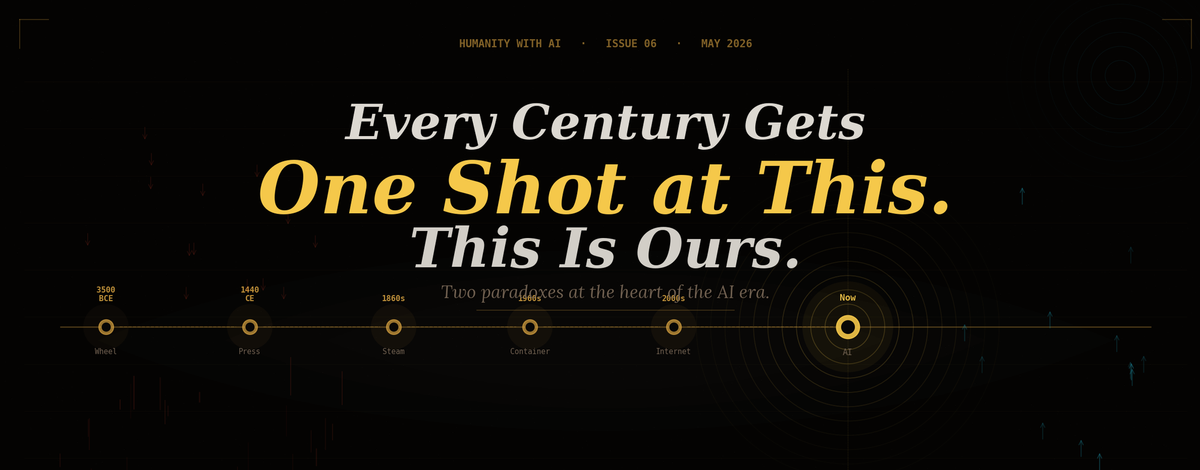
Two paradoxes at the heart of the AI era — and what the history of technology tells us about who actually benefits.
It is 6:47am. My phone already has seven notifications. My AI has drafted two emails, summarized three overnight Slack threads, and flagged a decision that needs my attention before 9am. I have not had coffee yet. I am already behind.
This was not the marketing pitch.
The pitch was simple: AI would give time back. Automate the routine. Eliminate the busywork. Free the human mind for higher-order thinking. The productivity dashboards at every company I work with confirm that AI is delivering on output. More emails sent. More reports generated. More code written. More decisions made.
And yet — ask anyone in a knowledge-intensive profession how they feel, and the answer is the same. Faster. Busier. More overwhelmed. Not less.
This is not a coincidence. It is a 160-year-old economic pattern playing out in real time. And it sits alongside a harder truth that most AI commentary is not willing to name: every technology cycle in history has carried this same paradox — and every one of them has also carried a shadow. Understanding both is the only way to think clearly about what comes next.
01 — The Coal That Never Ran Out
In 1865, a British economist named William Stanley Jevons noticed something disturbing. Steam engines were becoming dramatically more efficient — burning less coal to do the same work. Logically, this should have reduced England's total coal consumption. Instead, it exploded.
More efficient engines made coal-powered production cheaper. Cheaper production unlocked new industries and applications that had previously been too expensive to pursue. More industries meant more engines. More engines meant more coal. The efficiency gain didn't reduce consumption. It multiplied it.
Jevons called it a paradox. Economists have called it his paradox ever since.
"As AI gets more efficient and accessible, we will see its use skyrocket, turning it into a commodity we just can't get enough of." — Satya Nadella, Microsoft CEO, on DeepSeek's cost breakthrough, January 2025
Nadella was citing Jevons directly. When DeepSeek announced it had built a frontier AI model at a fraction of OpenAI's cost, the markets panicked. Nadella said: don't panic. When something gets cheaper, we don't use less of it. We find ten new uses for it.
He is right. And it applies beyond compute costs. It applies to human time itself.
Here is the mechanism: remove friction from a task, and two things happen simultaneously. The task gets done faster. And the number of tasks expands to fill the available capacity — and then some. The bar of what constitutes a "productive day" simply rises to consume every efficiency gain.
The data is not subtle:
- 77% of workers said AI tools increased their workload, not reduced it — Upwork Research Institute, July 2024
- 62% of professional developers now use AI tools regularly, up from 44% the prior year — yet 45% say AI tools still struggle with complex tasks — Stack Overflow Developer Survey 2024
- 1 in 3 employees say they will likely quit their jobs in the next six months due to burnout driven by AI-inflated workload expectations — Upwork Research Institute, July 2024
The Upwork number is the one that should give every productivity evangelist pause. Three in four knowledge workers say AI made their workload heavier, not lighter. They are not wrong and they are not complaining. They are experiencing Jevons in real time. Faster execution doesn't reduce demand. It raises expectations. The output that took a week now takes a day — so the expectation becomes five outputs per week, not one.
The Radiologist Who Was Supposed to Disappear
In 2016, Geoffrey Hinton — one of the godfathers of deep learning — famously declared that people should "stop training radiologists now." AI would outperform humans at reading medical images within five years. Nearly a decade later, demand for radiologists is at an all-time high.
AI can detect and classify hundreds of conditions faster than any human. And yet more scans are being ordered, more conditions are being screened for, and more radiologists are needed to supervise, verify, and integrate findings that AI surfaced but cannot act on alone. The Mayo Clinic in Rochester has grown its radiology staff by 55% since 2016 — to 400 radiologists. The friction of the old system was suppressing demand. Remove the friction, demand explodes. The governor is gone.
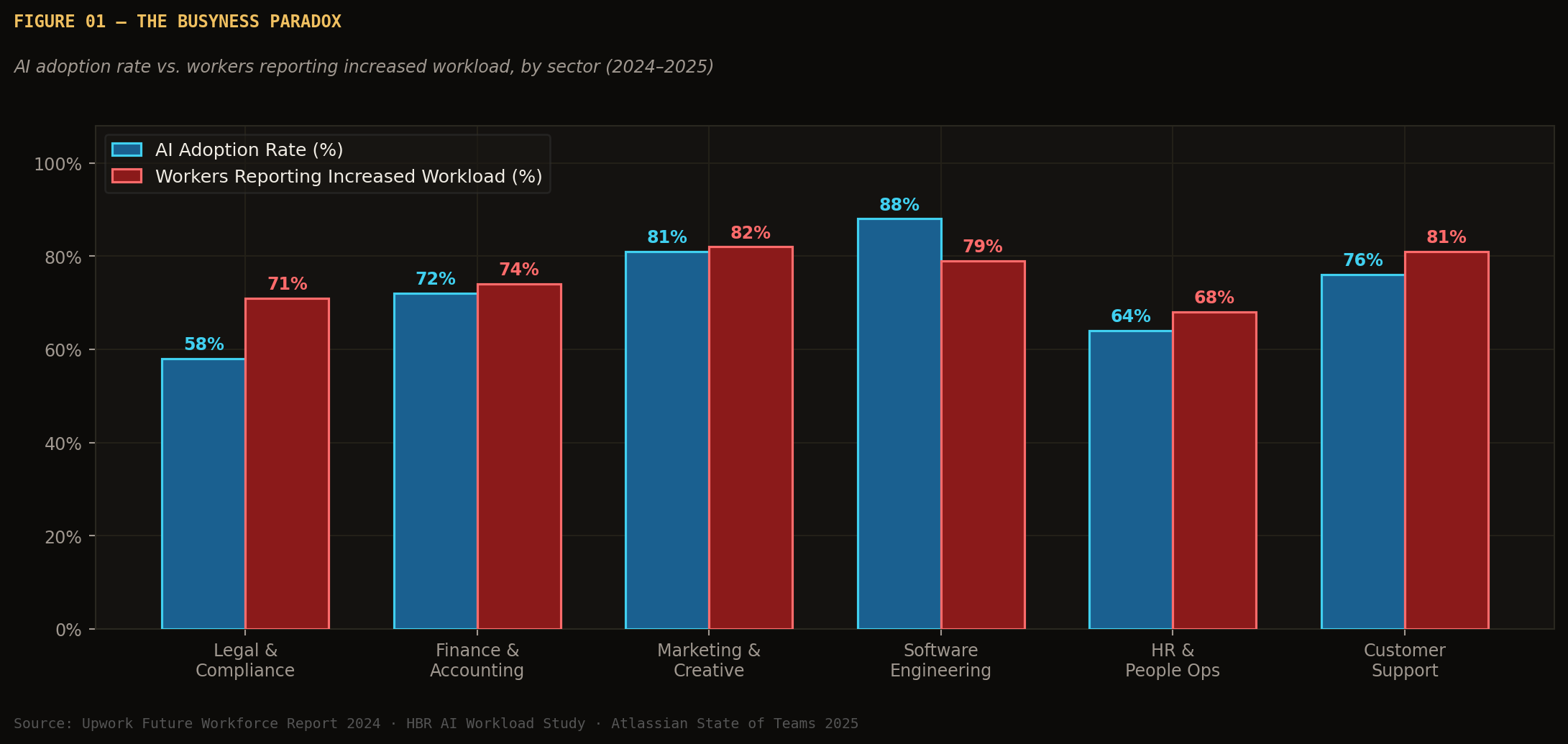
Sources: Upwork Future Workforce Report 2024 · Stack Overflow Developer Survey 2024
Every hour AI saves you, the market immediately demands you fill with three more. The efficiency gain doesn't buy freedom. It raises the floor of what a productive day looks like.
02 — Globalization at Mach 3
There is a second paradox running in parallel, and it operates at civilizational scale.
Every major technology cycle in human history has compressed distance. Not metaphorically. Physically, economically, culturally. The speed of that compression has followed a curve — and we are approaching its near-vertical phase.
~3500 BCE — The Wheel Extended trade from walking distance to cart distance. A merchant could reach markets 3–4 days away. Economic radius: 50–100 miles.
1440 CE — The Printing Press Moved ideas across continents in months instead of decades. Luther's 95 Theses reached all of Europe in 60 days. It took the Catholic Church 50 years to fully respond.
1860s — The Steamship & Telegraph Collapsed weeks of ocean travel into days. The telegraph moved financial information across continents in seconds — creating the first truly global capital market.
1960s — Container Shipping Reduced shipping costs by 90%. Created modern global supply chains. Global trade grew 10x over the following 50 years.
1990s–2000s — The Internet Made information instantaneous and universal. But barriers remained: language, cultural context, the friction of finding and evaluating information manually.
Now — AI Removes language. Removes context barriers. Removes the need to evaluate information manually. Not just information access — cognition, creativity, and cultural understanding at near-zero marginal cost.
But before we celebrate this arc as progress, history demands an honest accounting.
Every one of these technologies carried a dark shadow.
The printing press spread Enlightenment ideas — and it spread the charters that authorized the conquest of the Americas. The steamship connected continents — and it moved enslaved people across the Atlantic at industrial scale. The telegraph coordinated global commerce — and it coordinated colonial armies with unprecedented speed and efficiency.
The railways built across India in the 19th century are a precise example of how this works. The engineering was real. The infrastructure was real. But the railways were financed by Indian taxpayers, designed to move troops, and built to extract raw materials for imperial markets — not to connect Indian communities to each other. India, during this period, was a net exporter of grain to Britain even as famines killed tens of millions on the Indian subcontinent. The technology of extraction was working exactly as designed. The people it was pointed at paid the price.
This pattern has repeated across every civilization that has ever held superior technology at a particular moment in history — not because any one empire was uniquely more or less cruel, but because of something more fundamental. Power corrupts. Absolute power corrupts absolutely. Decades of research in psychology confirm what history already knew: access to power systematically reduces empathy, increases self-serving behavior, and narrows the circle of who counts as deserving. This is not a Western pathology or an Eastern one. It is a human one. The Romans, the Ottomans, the Mughals and every empire that followed — each held the tools of their era and each bent those tools toward consolidation rather than elevation. Not because they were monsters. Because unchecked power reliably produces that outcome regardless of who holds it.
The question is never whether people in power will use technology to consolidate that power. History answers that clearly: they will. The only question that matters is what countervailing forces exist to check it — the institutions, the norms, the distributed access, the accountability structures that point the technology somewhere better.
And yet — and this is equally important — within every one of those empires, in every century, people stood up against it. It would be tribal and historically false to frame this as East versus West, or one civilization against another. The conscience that resisted extraction was never the property of the oppressed alone.
A.O. Hume was a Scottish civil servant inside the British administration who founded the Indian National Congress in 1885 — the organization that eventually played key role in India's independence. He was distrusted by his own government and viewed with suspicion by some Indian nationalists. He wrote poetry urging Indians to build their own nation and served the Congress as general secretary for 22 years, at personal cost. William Wilberforce spent decades inside the British Parliament fighting to abolish the slave trade — and succeeded in 1807. Bartolomé de las Casas, a Spanish priest who had himself participated in the conquest of the Americas, spent the rest of his life documenting its atrocities and arguing before the Spanish Crown that indigenous people had rights. Trevor Huddleston, a British priest in South Africa, became one of the most vocal opponents of apartheid decades before the world paid attention. The Northern states of the United States fought a civil war against slavery at the cost of 600,000 lives.
The point is not that these individuals cancelled out the harm. The harm was real and its consequences are still with us. The point is that the struggle between power and conscience has always been a struggle within the conscience and self image of humanity itself — not between nations, not between civilizations, but inside every one of them simultaneously. In every era, in every society, there have been people who chose differently — who looked at what unchecked power was doing and said: not in my name.
That is the human capacity we need to scale. Not just the technology.
Every century has failed to build those checks fast enough. That is the pattern. That is the only lesson.
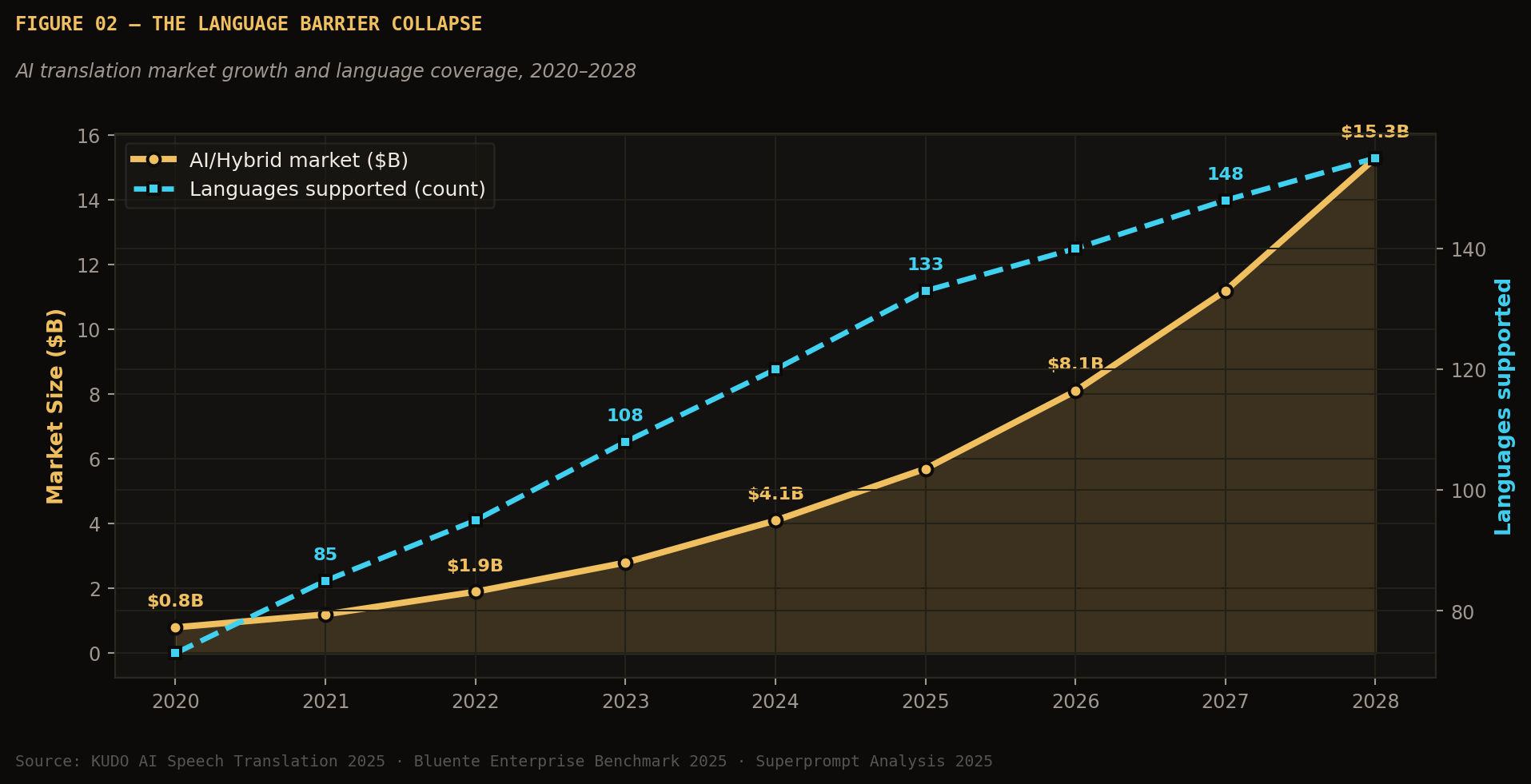
Sources: AI Speech Translation Report 2025 · Superprompt AI Translation Analysis 2025
In 2024, AI translation handled 65 percent of all global translation volume — a complete reversal from 2021, when human-only translation dominated at 72 percent. AI now achieves 96 percent accuracy across 133 languages. Real-time speech-to-speech translation became commercially viable in 2025. The language barrier — one of the last structural governors on the speed of cultural exchange — is collapsing in real time.
A student in Lagos today has access to the same reasoning infrastructure as a researcher at Stanford. Not theoretically. Practically. Right now. They can ask a question in Yoruba and receive an answer as nuanced as one from a domain specialist. The friction of geography, language, and access that defined what knowledge was available to whom — for all of human history — is dissolving in a decade.
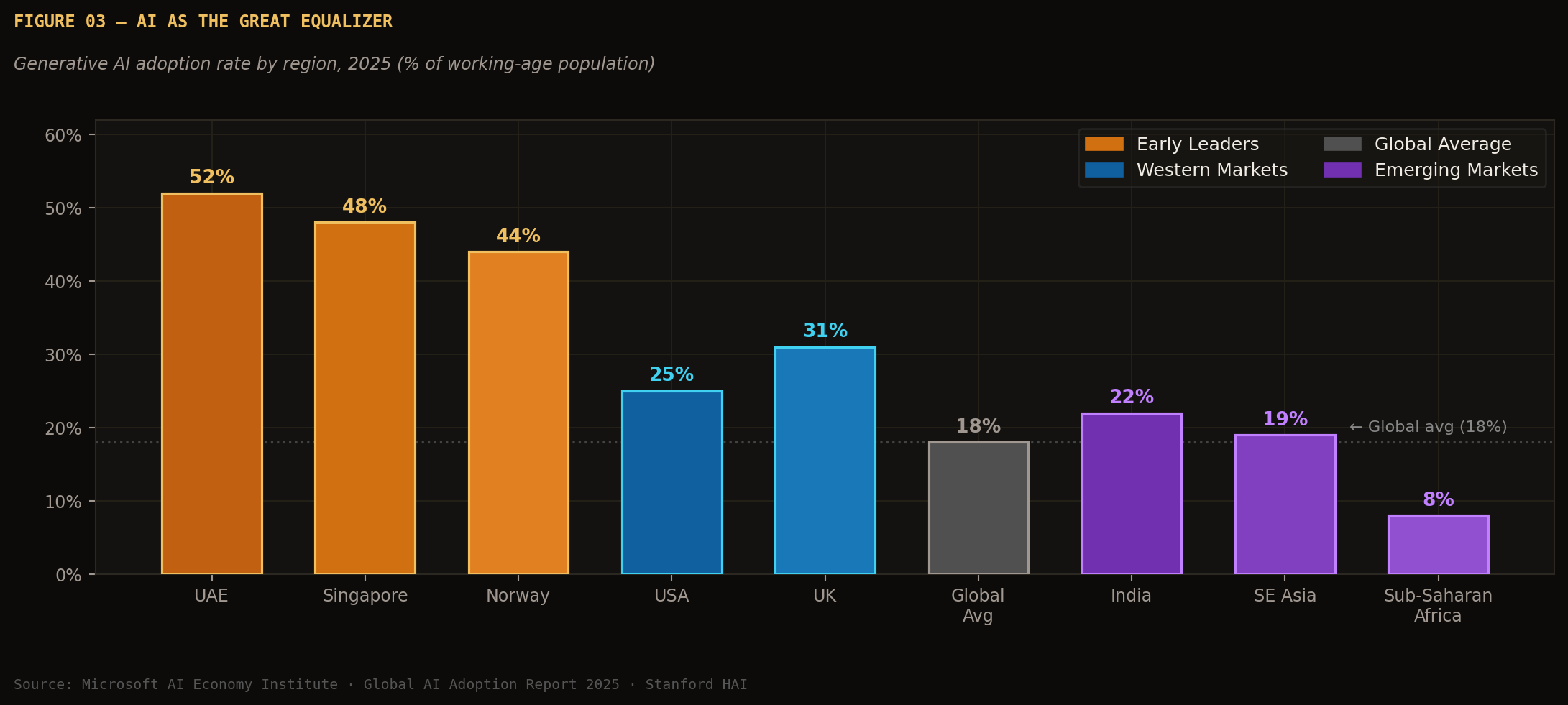
Source: Microsoft AI Economy Institute · Global AI Adoption Report 2025 · Stanford HAI
This will produce the most rapid civilizational integration in human history. If the internet was a train, AI is Mach 3.
And like every previous compression, it will produce friction before it produces harmony. A worldview shaped by Confucian hierarchy, a worldview shaped by Western individualism, a worldview shaped by Ubuntu philosophy, and a worldview shaped by Vedantic oneness or Buddhist impermanence will now occupy the same informational space simultaneously — without the buffer of distance or the pacing of slow diffusion.
And here is what I believe that encounter will eventually reveal: we are far more similar than we think.
The so-called divide between East and West, between the religious and the secular, between the conservative and the progressive — these are surface layers. They are the product of where you were born, which parents raised you, which friends shaped you, which stories your culture told you about who the enemy was. Strip those away and you find the same basic human psychology underneath. The same fear of loss. The same need for belonging. The same desire to matter. The same love for children. The same dread of death.
AI — by collapsing distance and enabling genuine cultural exchange at scale — could be the most powerful force for dissolving those surface layers in human history. Not by erasing difference. By revealing how thin the layer of difference actually is compared to the depth of what is shared.
That process will be uncomfortable before it is liberating. But contact — real, sustained, frictionless contact between civilizations — has always been how humanity discovers it was arguing about the outer coat while wearing the same skin underneath.
The world will be a village in 50–100 years. Not metaphorically. Operationally. The question is not whether this happens. It is whether, this time, all of humanity gets to benefit from it.
03 — The Governor We Didn't Know We Had
Here is the uncomfortable truth underneath both paradoxes.
The busyness. The distance. The language barriers. The slow diffusion of ideas across cultures and continents. We called all of these things problems to be solved. Inefficiencies to be eliminated. Friction to be designed away.
We were not wrong. They were inefficiencies.
But they were also doing something else. They were pacing human adaptation. They gave individuals, institutions, and societies time to absorb change before the next wave arrived.
The printing press took 50 years to destabilize the Catholic Church's information monopoly. The internet took 30 years to fully reshape commerce, media, and social behavior. Each generation had a chance to adapt before the next disruption arrived.
AI is compressing that adaptation window from decades to years. Possibly to months.
Consider what this means for the individual knowledge worker. Every previous productivity technology — email, the spreadsheet, the smartphone — required years before it reshaped job expectations. You had time to learn the tool before the tool became the baseline. AI is reshaping expectations faster than individuals can adapt to it. The worker who adopted AI six months ago is already behind the worker who adopted it three months ago. The baseline is moving faster than the learning curve.
The Jevons pattern in labor markets is consistent:
- AI has added 1.3 million new jobs globally in two years — including AI Engineers, Forward-Deployed Engineers, and Data Annotators — LinkedIn/World Economic Forum, January 2026
- 59% increase in new AI job postings between January and November 2024 — University of Maryland & LinkUp AI Job Tracker
- 62% of professional developers now use AI tools, up from 44% the year before — Stack Overflow 2024
Efficiency technologies don't eliminate the occupation. They multiply the demand for it. The same will happen with AI-augmented roles. But the transition is not painless and it is not instant. The friction that slowed previous transitions — the friction we spent decades trying to eliminate — was the buffer that made them survivable.
We optimized away the pacing mechanism of human civilization. What we called inefficiency was actually the architecture of adaptation.
04 — Every Century Gets One Shot at This. This Is Ours.
None of this is a reason to slow down AI. You cannot uninvent the printing press. You cannot un-collapse the language barrier. The friction is gone and it is not coming back.
But this moment is different from every previous technology cycle in one crucial way: we can see the pattern before it completes.
We know how this has gone before. We know that technology is agnostic — that it does what its owners point it at. We know that the narrative of liberation has historically been written by the people who owned the infrastructure, not the people who paid for it. We know that efficiency without equity produces concentration, not elevation.
For the first time in history, the infrastructure of intelligence is not owned exclusively by one empire, one continent, or one civilization. AI is imperfect, unequal, and already showing early signs of the same concentration dynamics that characterized every previous cycle. But the window is still open — narrowing, but open — to point it differently. Not at extraction. At elevation. Not at subjugation. At genuine solidarity between civilizations that are, underneath the surface layers of history and grievance, far more alike than centuries of engineered division have led us to believe.
That is not naivety. It is the most radical and necessary bet humanity has ever been asked to make.
For the individual: The Jevons effect is coming for your time. Decide in advance what you will do with the capacity AI frees up, rather than letting the market fill it automatically. Intentionality is the only protection against the paradox.
For societies: The village is coming. It will be loud before it is harmonious. The friction of contact between value systems is how universal values are forged — not by one side winning, but by the encounter revealing what was true in each.
For institutions: The adaptation window has collapsed. The only durable strategy is building the capacity to adapt continuously — not building the perfect adaptation to what exists today.
What do you do with the hours AI saves you when the market immediately demands you fill them?
What happens to human identity when the village is literally global and your values are suddenly one of eight billion options?
And this time — who actually benefits?
If this made you think, share it with one person who needs to. That is how we grow this conversation.