Rise of AI: Why You Should Be Terrified
While social algorithms optimize for outrage, my goal is to drive understanding through data . Like the parable of the blind men and the elephant, everyone is touching a different part of the AI revolution. I am here to reveal the "whole elephant" by filtering out the noise .
Origin Story
I know that provocative headlines like the one above get more eyeballs.
The algorithms aren't directly trained to create outrage. They are trained for engagement. But they collide with our own evolutionary biology. We are hardwired to prioritize negative signals and threats to keep ourselves safe. When you mix engagement algorithms with our survival instincts, you get the "outrage loops" we see today.
This is the first and last time we will use that trick here.
We are doing things differently. In 2025, the word of the year wasn't "Innovation." It was "Slop.". It describes the low-quality, AI-generated filler clogging our collective consciousness. Our goal is to drive understanding, not just attention. Our promise is simple: We put the data in front of you first and let you form your own opinion. No one has a monopoly on the truth.
The Secret the Experts Won't Tell You
In my daily work, I talk to the leaders and decision makers of the world's biggest companies. In public, they sound very sure of themselves. But in private, they all say the same thing: Nobody knows what is going to happen next.
There is a lot of uncertainty behind the scenes. Even the people building these new tools are surprised by how fast things are moving. If you feel a bit lost or worried, you aren't alone. Even the experts are trying to figure it out as they go.
The Uncertainty, Measured
Don't take my word for it. Look at three signals:
- 95% of enterprise GenAI pilots produced no measurable financial return — even as spending climbed past $30–40 billion (MIT Project NANDA, 2025)
- When 2,778 AI researchers were surveyed, their forecasts for when machines outperform humans at every task spread across decades. The people building this disagree with each other by 40+ years (AI Impacts, 2024)
- 52% of Americans say they are more concerned than excited about AI — while adoption keeps accelerating anyway (Pew Research, 2023)
Hold those three together: the money is flowing, the builders disagree, and the public is anxious. Everyone is touching a different part of the animal. Which brings me to an old parable.
The Whole Elephant
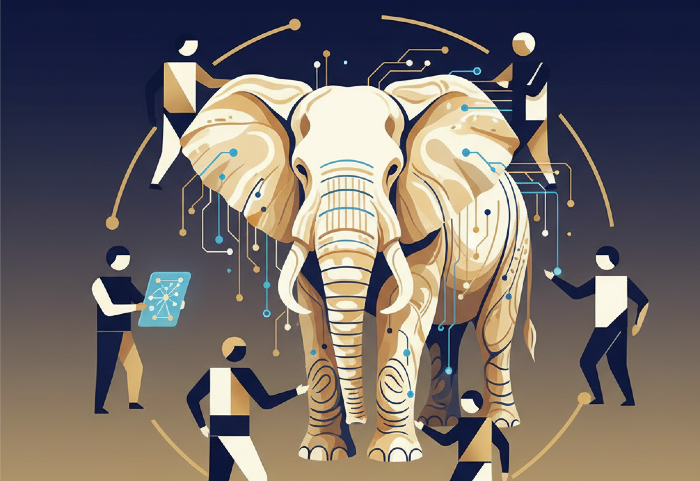
There is an ancient parable about "The Five Blind Men and the Elephant.". One touches the tail and thinks it’s a rope; another touches the side and thinks it’s a wall. They are all telling the truth from their limited perspective, yet they miss the ultimate reality .
We are in the same situation with AI. Everyone—from the billionaire optimist to the worried parent—is touching a different part of the beast. My goal is to combine these isolated data points to reveal the "whole elephant." We aggregate the signals and filter out the noise to understand this revolution in its entirety .
What I’ve learned is that the old ladder of success is breaking. I am navigating these uncharted waters alongside you, with an insider’s map and a data-first compass.
But seeing the whole picture is only the first step. Once we see what is coming, we face a choice that will define the next decade.
The Real Fork in the Road
The rise of AI is changing the nature of work. It is taking over the boring, repetitive tasks—the "grunt work"—that drains our energy. But where we end up as a society depends on which path we choose right now.
Path 1: Giving Away Control In this scenario, we leave the big decisions to the 1% and the politicians who already have all the resources. We sit back and "hope for the best," giving away our control and hoping that others will make the right choices for us. We become passengers in a car we no longer steer.
Path 2: The Collective Voice (The Goal) In this scenario, we come together as a group of experts, leaders and context aware citizens to influence the policy makers and industry leaders. We guide the tech revolution toward the common good.
In this version, the massive gains in productivity don’t just help a small group of people. Instead, they become a tool to take all of humanity to the next level. We build a world where people don't have to worry about food on the table or a roof over their heads. We buy back the time to solve harder problems, ask deeper questions, and spend our lives doing the things we actually love.
Taking the Controls
Humanity with AI is for people who choose Path 2.
We believe technology should be the Wind in our Sails. It is a powerful, invisible force that can carry us across the ocean, but it has no sense of direction. It provides the power, but it doesn't know where the shore is. If we just sit still, the wind will blow us wherever it wants. But if we set the sails and hold the rudder, we can reach a destination that was previously impossible.
When we stop reacting and start looking at the facts, we get our power back. We stop being passengers in the backseat and start driving our own lives. I’m here to help you plan your own path rather than just waiting to see what the tech world decides for you.
In the next post — Signal vs. Slop — I share the first set of raw signals from the Synthetic Age, and how to find your agency within it.