The Great De-Coupling: When Capital No Longer Needs Labor
How AI will kill the system that created it — and what comes after.
Two months. That is how long it took King County, WA to assign someone to review my septic and well application. Two months of silence, then three escalation calls and an email before an inspector was assigned. If slow application processing were an Olympic sport, King County would be in medal contention. They had modernized their systems — but the upgrade had stalled their actual work
I help some of the largest companies on earth move data at scale. Then I go home and wait two months for a county to assign someone to my permit application. Data is how systems know what they are doing. When data flows cleanly, decisions are fast and accurate. When data is corrupted or delayed, friction spreads everywhere. A county cannot process septic applications. A hospital cannot schedule surgeries. A business cannot allocate resources. The cost of poor data architecture and governance is paid by real people waiting.
And here is what haunts me: the world of bits is moving at exponential speed. The world of atoms — permits, inspections, infrastructure, education, the justice system — is still asking for forms in triplicate. This collision is the story of the next decade.
But to understand where we are going, we need to understand what got us here.
The Algorithm That Works
Capitalism is not perfect. It is, however, the most effective resource allocation algorithm humanity has discovered.
When capital and labor are scarce, price signals work. Inefficiency is punished. Efficiency is rewarded. The system continuously reallocates capital from less productive deployments to more productive ones. It does not require central planning, ideological agreement, or cultural uniformity. It requires one thing: the freedom to move resources toward better outcomes.
The evidence is stark.
The United States, post-World War II, built the world's largest economy through capitalist market structures — growing from 228 billion dollars in GDP in 1945 to over 27 trillion dollars today. But the most compelling proof of capitalism's power is not the country that started rich. It is the countries that started with nothing.
South Korea in 1955 had a GDP per capita of 64 dollars. It was among the poorest nations on earth, devastated by war, with no significant natural resources. By 2024, that figure had reached 36,282 dollars — a 567-fold increase in 70 years. The mechanism: market-driven capital allocation that systematically moved resources into semiconductors, electronics, and automotive manufacturing. Samsung, Hyundai, and LG are not accidents of geography. They are outputs of an algorithm that rewards efficiency.
Singapore followed the same logic. A small island city-state with no natural resources and no agricultural base, it achieved per capita income higher than the Western European average by the mid-1990s. Japan rebuilt from post-war devastation into the world's third-largest economy. Taiwan transformed into a global semiconductor power. Each story is different in culture and context. The mechanism is identical.
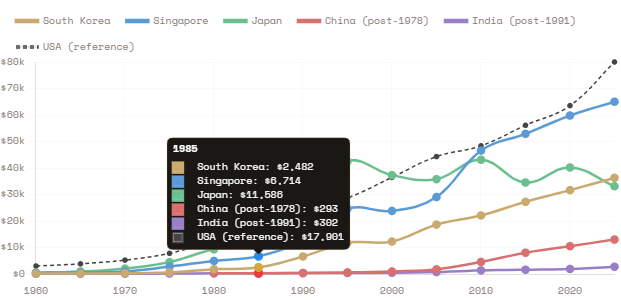
Figure 01 — Economic TransformationGDP per capita in USD, 1960–2024 · India inflection marked at 1991 reformsSources: World Bank · IMF World Economic Outlook · Swiss State Secretariat for Economic Affairs (2025)
But the hardest case — and the most instructive — is China and India.
Popular belief holds China as communist. Technically, it is — in political structure and governance. Economically, it is ferociously capitalist. Before 1978, China operated a command economy. Central planning allocated resources based on ideology, not efficiency. The results were stagnation. Then Deng Xiaoping introduced market reforms. Capital was allowed to flow toward productive use. Inefficiency was, slowly, penalized.
What followed is the most dramatic economic transformation in recorded history.
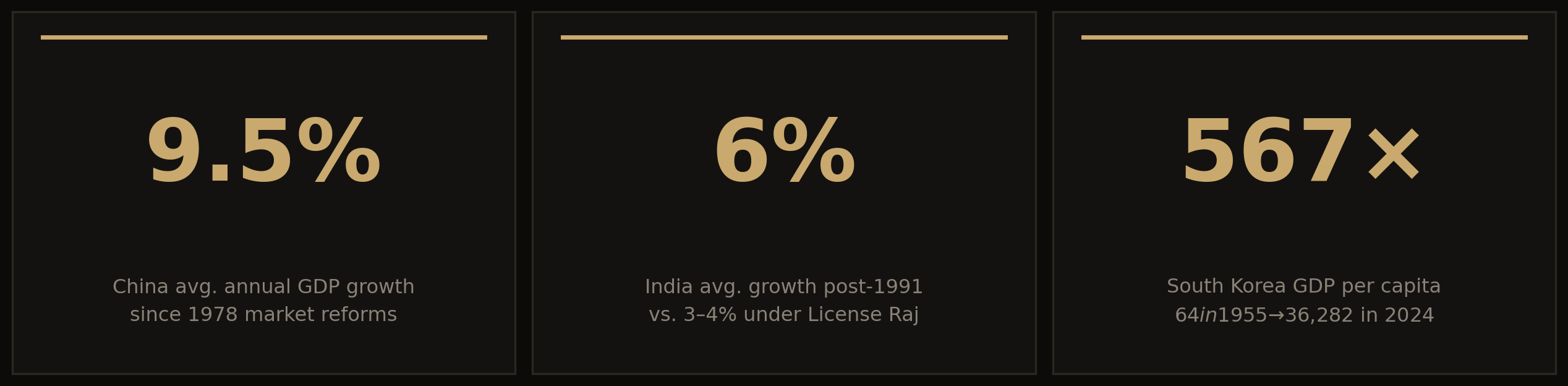
Since 1978, China's GDP has grown at an average annual rate of 9.5 percent, compounded. A 150 billion dollar economy became a 17 trillion dollar economy. Hundreds of millions of people moved out of poverty in a single generation. Not because of communism. Because of the capitalist layer operating beneath it.
India tells a different but equally instructive story.
For the first three decades after independence, India ran a socialist-leaning mixed economy — heavy state control, protected industries, and a licensing regime so burdensome it earned the name "License Raj." GDP growth averaged 3 to 4 percent annually through the 1960s and 1970s. Then in 1991, facing a balance of payments crisis so severe that the government airlifted gold reserves to secure an emergency IMF loan, Finance Minister Manmohan Singh tore open the economy. Licenses were dismantled. Foreign investment was welcomed. Markets were allowed to price goods and services closer to their actual value.
The results were stark. India's average growth rate rose from 3–4 percent in the pre-reform era to 6+ percent post-1991. GDP per capita, which sat at 375 dollars in 1990, crossed 2,700 dollars by 2024 — still modest in absolute terms, but a trajectory that has made India the world's fifth-largest economy and its fastest-growing major one. India remains a mixed economy — strategic sectors like defense, nuclear, and railways retain state control — but the capitalist engine beneath has driven a transformation its socialist framework never could.
The pattern is unmistakable across every case: command and control suppresses the algorithm. Market opening releases it.
The system works because it is an algorithm. And good algorithms scale. But algorithms have edge cases. We are entering one.
The Edge Case
The algorithm has one vulnerability. It is built entirely on scarcity.
Capitalism works because resources are finite. Capital is limited. Labor is limited. Energy is limited. When those constraints exist, price signals function. Efficiency is rewarded. The system self-corrects.
But something is happening at the foundation of that scarcity assumption — and the data is not subtle.
Compute costs have fallen approximately 17 percent per year for the last decade. The performance you could buy for one dollar in 2014 costs fractions of a cent today. AI is not expensive infrastructure for the elite — it is becoming ambient, like electricity. Meanwhile, the global stock of industrial robots reached 4.66 million operational units in 2024, growing at 9 percent year-over-year. These robots are not replacing assembly line workers in isolation — they are entering healthcare, logistics, agriculture, and professional services simultaneously.
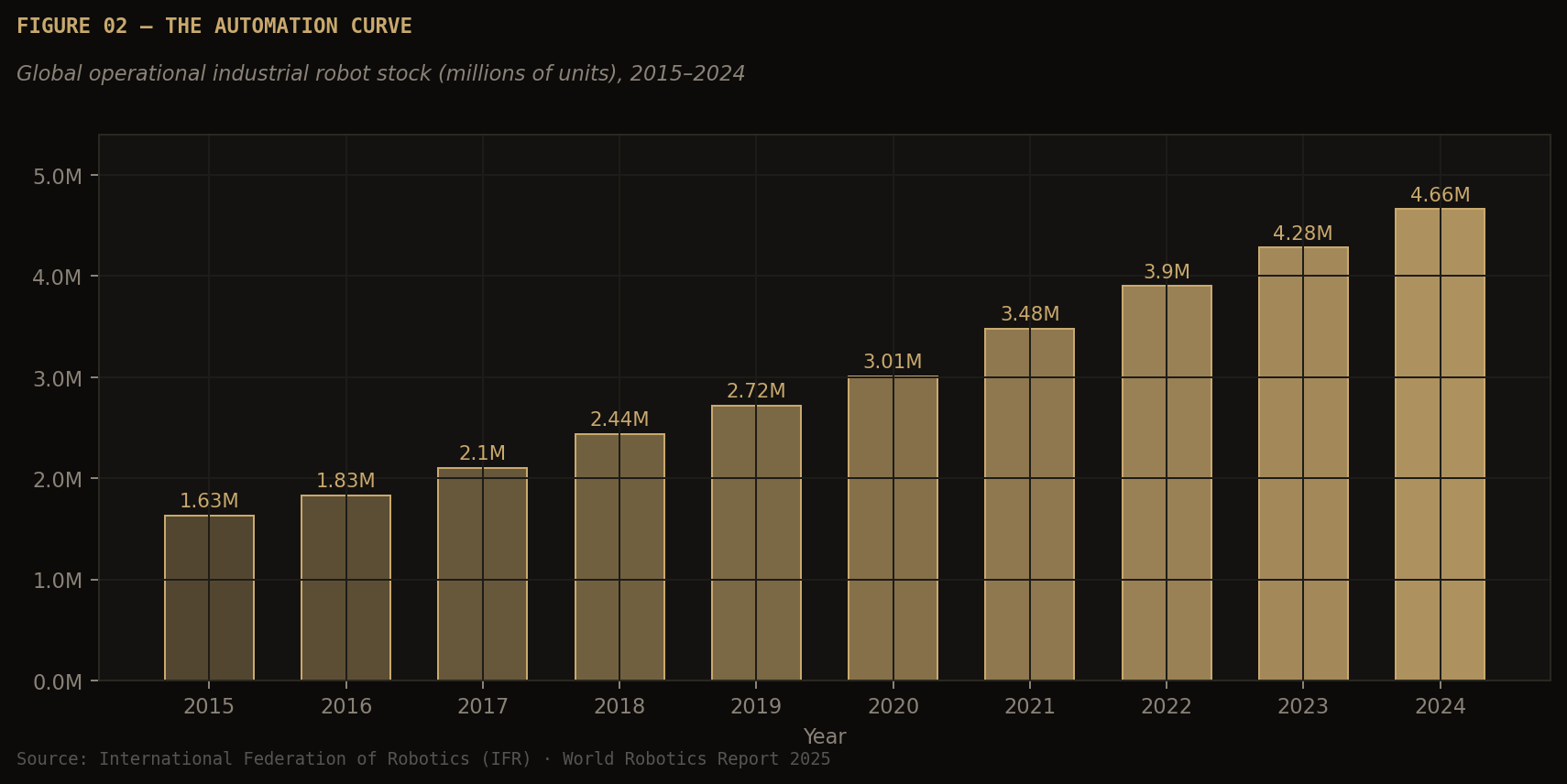
Figure 02 — The Automation Curve. Global operational industrial robot stock (millions of units), 2015–2024
Source: International Federation of Robotics (IFR) · World Robotics Report 2025
These are not projections. They are current measurements. And there is a feedback loop forming that Elon Musk described plainly in a recent interview: chips, AI, and energy form a virtuous cycle. Better chips power better AI. Better AI optimizes energy systems. Lower energy costs enable more chips. Robotics enters the loop. Each revolution of the cycle makes the next revolution faster and cheaper.
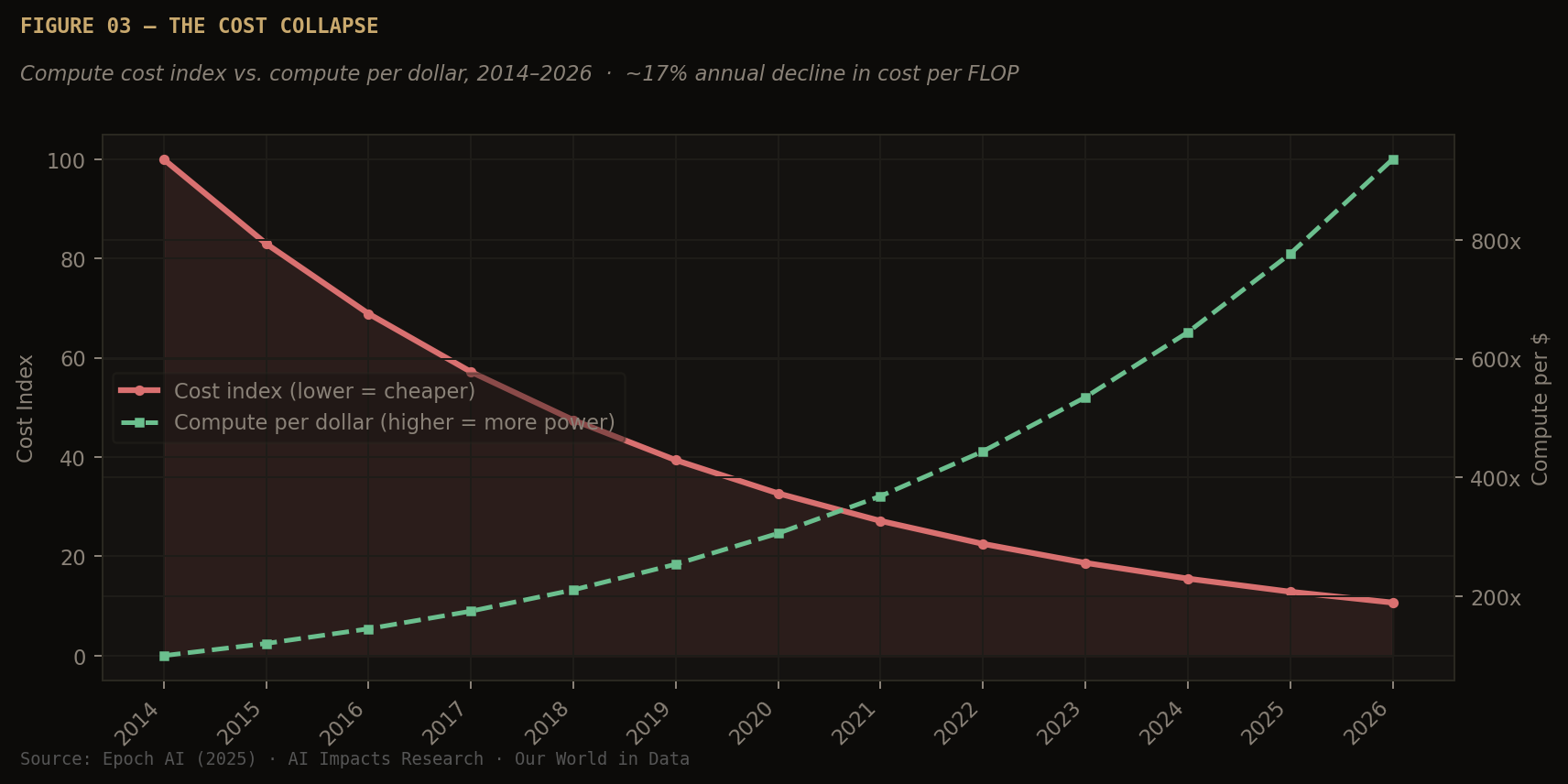
Figure 03 — The Cost Collapse. Compute cost index vs. compute per dollar, 2014–2026 (normalized, ~17% annual decline)
Source: Epoch AI (2025) · AI Impacts Research · Our World in Data
At some point along this curve — and no one can tell you exactly when — the inputs to capitalism begin approaching zero marginal cost. Energy becomes abundant. Labor automation becomes near-universal. Intelligence becomes infrastructure.
And an algorithm built on scarcity has no instruction set for abundance.
What sustains a system built on scarcity when scarcity disappears? This is the question capitalism has never had to answer in 300 years. It is about to.
Coming in the Next Issue Three Scenarios. One Question.
We follow the data to its logical end. Three scenarios for what emerges when the algorithm meets abundance — with honest probability estimates for each.
- The Managed Transition - Governments and markets adapt before the fracture. A new economic framework emerges — painful, uneven, but functional.
- Concentration and Conflict - The virtuous cycle gets captured. A small class controls the infrastructure of intelligence. The gap becomes structural, not cyclical.
- Post-Scarcity Leapfrog - The cycle runs faster than anyone predicted. The question of "who pays for this" becomes moot. The most disorienting — and potentially most liberating — scenario of the three.
The same system that produced the greatest reduction in human poverty in history may be building the technology that makes its own logic obsolete. Our job is not to save the machine. It is to decide what we build in its place.
That is not a crisis. It is a question. And it is the most important question of our time.
If this made you think, share it with one person who needs to.